
Landfill - Methane Capture

Methane Capture - Landfill management includes layering and compounding of waste in a series of layers to promote microbial decomposition, largely through anaerobic digestion. During anaerobic digestion, microbes break down organic waste, releasing gases such as methane, carbon dioxide and hydrogen sulphide. As such, landfills must find ways of limiting emissions of these gases into the atmosphere. Methane and CO2 are both greenhouse gases, and methane may pose a flammability risk. Hydrogen sulphide contributes to acid rain and must be similarly mitigated.
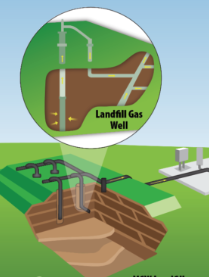
Active LFG collection commonly uses vacuum extraction methods connected to a series of underground vent pipes, often called “gas extraction wells” or “gas collection wells". Extraction is conducted throughout the site's working life and continues after the landfill is capped, for up to 20 years or longer. LFG beneficial-use facilities extract and process the methane into renewable natural gas or biomethane. The gas can be combined with pipeline gas or used to generate electricity.
Precision control is important because if an insufficient vacuum is pulled, then LFG will escape to atmosphere. Conversely, if too much vacuum is pulled at the LFG well, then atmospheric air will be pulled in along with the LFG. Most commonly, the vacuum level at each well is set via a plastic, manually adjustable ball or butterfly valve. Manual adjustments may introduce a system “cross-talk” effect. Changing the vacuum level on one well can impact the flow through neighbouring wells. This can make optimising the vacuum at each well a very lengthy process.
An EVR can offer a fully automated solution to the problem. The EVR is a non-relieving vacuum regulator that throttles the flow between the vacuum supply pump and the well system to precisely control the system vacuum at a specific set point. The valve instantaneously and independently adjusts its Cv in response to changes in flow.
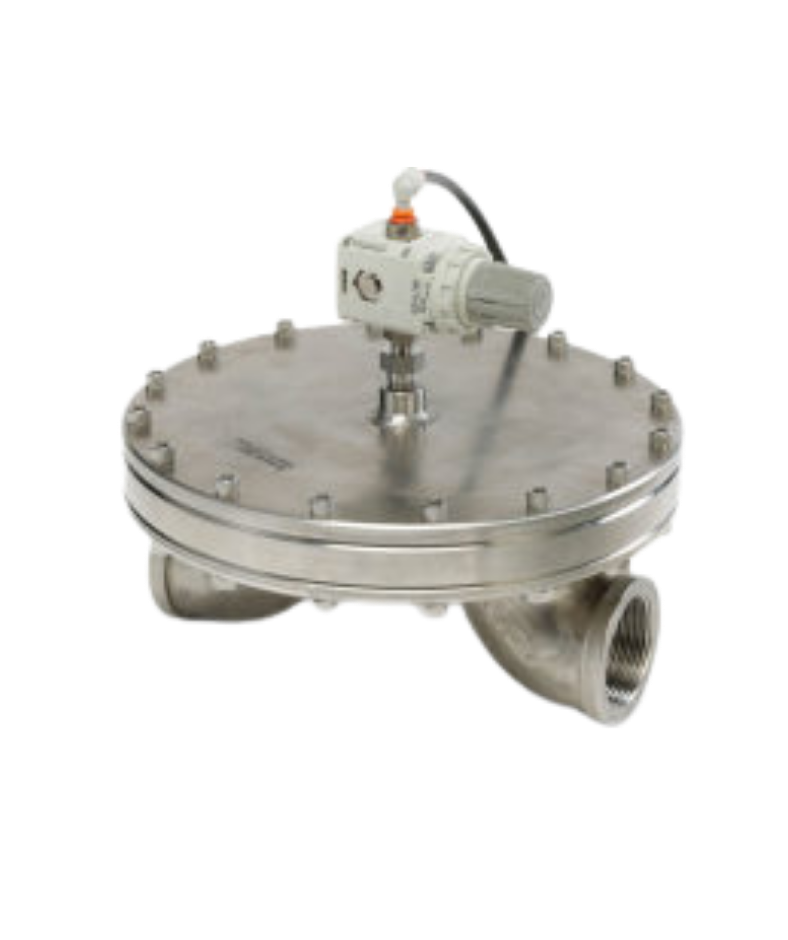
An EVR is a dome-loaded pilot-operated regulator, so the setpoint is determined by a vacuum pilot regulator on the dome of the device.
The EVR will maintain a vacuum level on a 1:1 ratio with the vacuum setting of the vacuum pilot regulator. It should be noted that while an EVR is often placed downstream of a condensate knockout tank, this is not strictly necessary. All EVRs are able to handle mixed-phase liquid/gas flow.
Unique advantages EVRs offer for LFG capture systems
Automatic adjustment of Cv – unlike the more commonly used manual ball or butterfly valves, a true vacuum regulator like the EVR, adjusts its Cv on the fly to keep the setpoint constant.
Wide operating Cv range – the amount of gas produced by wells can vary wildly, as temperature and other environmental factors influence the rate of gas production from the anaerobic digestion. All EVRs have an operating Cv turndown ratio of at least 100:1, with >1000:1 turndown being achievable in most cases. If the amount of flow changes, from changes in gas produced by digestion, permeability of soil, or adjustment of nearby wells, the Equilibar can instantaneously adjust its Cv to compensate and maintain the set vacuum level.
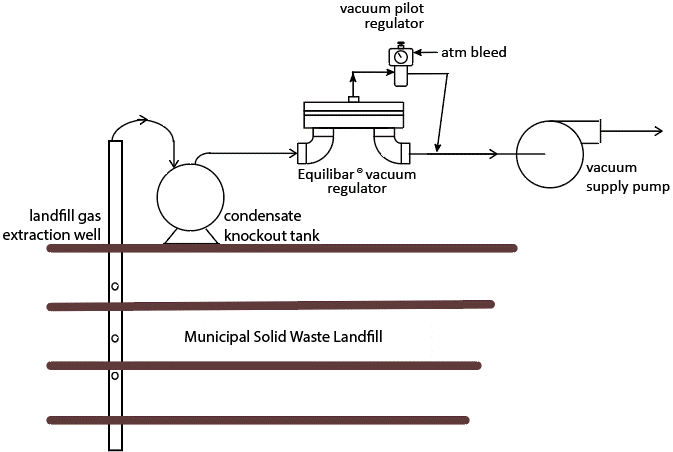
An EVR is uniquely suited for the challenging conditions inherent to LFG capture. The EVR can be installed upstream of the vacuum pump to maintain a constant vacuum on the gas collection well regardless of the vacuum source or system pressure.
Ability to handle variable vacuum supply – the vacuum supply provided by a shared header line or blower is not always constant. For a traditional control valve, a change in downstream vacuum supply pressure requires an adjustment of the valve’s % open (and resultant Cv). The EVR automatically adjusts its Cv in response to either fluctuations in flow or downstream pressure while keeping the pressure on its inlet constant.
Materials for chemical compatibility – the simple design of the EVRs allows for easy customisation to ensure that the valve can handle a variety of
other chemicals that may be present in LFG, such as hydrogen sulphide. PTFE and Viton seals are commonly used in our EVRs, and the body of the valve itself can be made from either metal bar stock
like SS316 or polymers like PVC, PTFE, PVDF, or HDPE.
Reduced maintenance time – the simple design of EVRs, relying only on a flexible diaphragm and a set of O-rings, allows them to be rebuilt faster than
traditional control valves. Unlike other control valves, there is no recalibration or adjustment required after maintenance.
Interested
To discuss our extensive range of products and systems, or your application contact us on:
email: sales@proportionair.eu
emai.l:usa-sales@proportionair.eu
UK: +44 (0) 2477671600
 Print
Print